ReGroup

Overview
India’s concert culture has grown rapidly since the late 2000s with festivals like Sunburn and NH7 introducing large-scale music events. After the COVID-19 pandemic, the industry saw a major boom, with more international artists performing in India than ever before. As large crowds became more common, many people faced difficulties staying connected with their groups during concerts.
This project aims to solve the problem of people getting separated in crowded venues and struggling to find their friends again.
Role & Duration
Lead Product Designer
User Research
Visual Design
Interaction
Prototyping
June 25 - August 25
The Problem
Concerts and music festivals in India are attracting larger crowds than ever before, making it difficult for groups to stay connected in crowded venues.
Poor network connectivity, loud environments, and limited location awareness often cause people to get separated from their friends, leading to stress, confusion, and a disrupted concert experience.
User Research
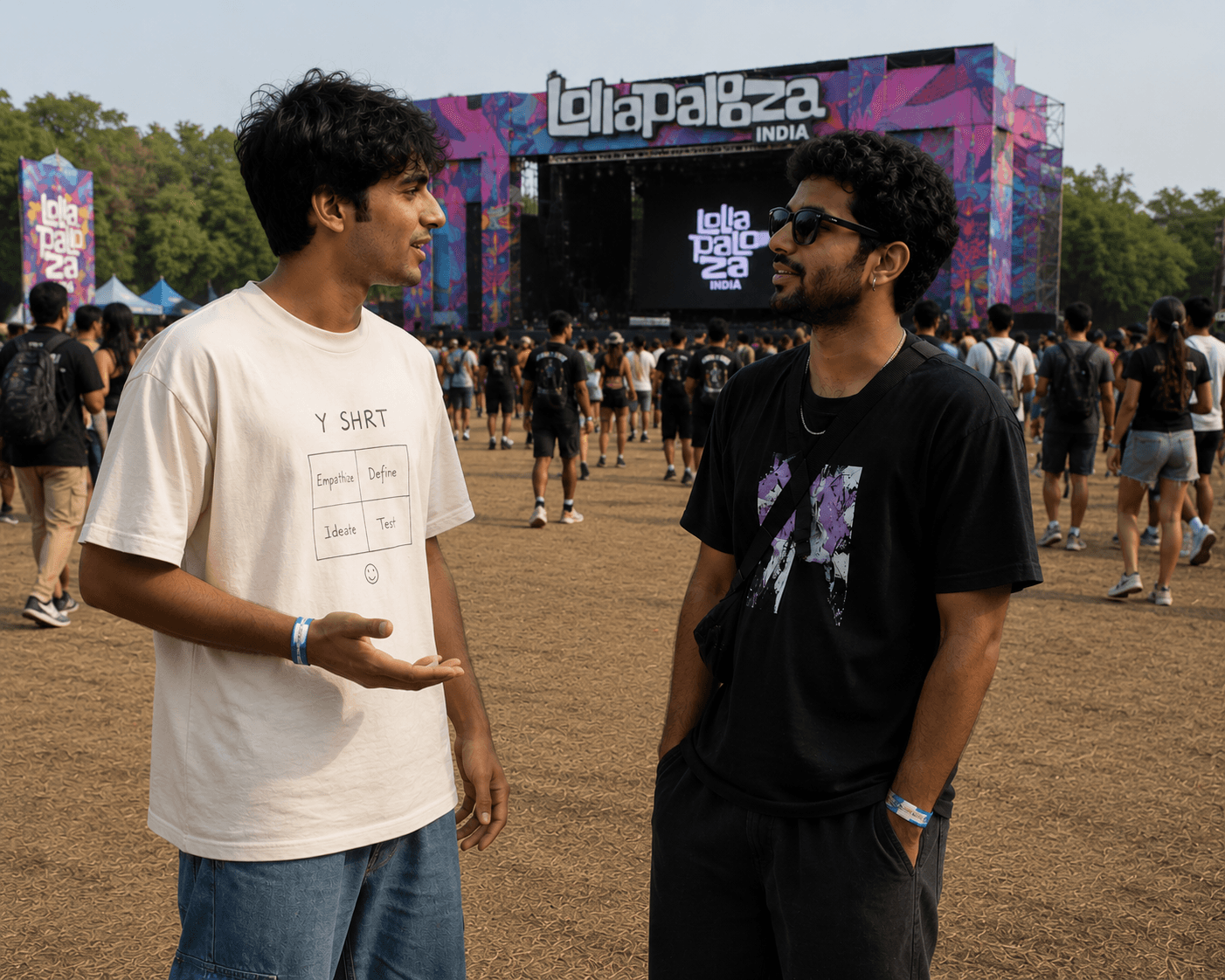
Qualitative Interviews
User research played an important role in understanding the challenges concert attendees face during live events. Since the primary user group consisted of young concertgoers, I conducted interviews to learn about their experiences, behaviors, and frustrations while attending crowded concerts and festivals. These insights helped identify key pain points and understand how a digital solution could improve group coordination and the overall concert experience.

“During concerts, our group often gets separated because of the huge crowd and poor network connection. Calling or texting doesn’t always work, and finding each other again takes a lot of time and ruins the experience.”
— Concert Attendee, 22

"We usually decide on a meeting point before the concert starts, but once the performance begins, it's almost impossible to get back there through the crowd. We end up spending more time looking for each other than enjoying the show."
— Concert Attendee, 27
Insights
After conducting user interviews and analyzing attendee experiences, the insights were grouped into two major problem areas:
Group Separation in Crowded Areas
Users often get separated from their friends during concerts due to heavy crowds, stage transitions, and movement across large venues.
Poor Communication During Events
Weak network connectivity and loud environments make calls and messages unreliable, making it difficult for groups to reconnect quickly.
User Profiles
User interviews revealed recurring challenges around group coordination, unreliable connectivity, and navigating crowded venues. Based on these insights, I developed two personas that represent the different needs, behaviors, and motivations of concert-goers attending live events.

Aarav Mehta
Age : 26
Occupation : Software Engineer
Location: Bengaluru, India
Concert Attendance: : 4–6 events per year
"I don't mind getting separated for a few minutes, but I hate spending half the concert trying to find my friends again."
Bio
Aarav enjoys attending music festivals and concerts with his friends. He values shared experiences and often coordinates plans for large groups. During crowded events, he frequently struggles to stay connected with friends due to poor network coverage and constantly moving crowds.
Goals
Stay connected with friends throughout the event.
Quickly reunite with the group if separated.
Spend more time enjoying performances and less time coordinating logistics.
Avoid missing performances while searching for friends.
Pain Points
Mobile networks become unreliable during large events.
Calls and messages are delayed or fail completely.
Finding friends in dense crowds is stressful and time-consuming.
Agreed meeting points become difficult to reach during performances.

Priya Sharma
Age : 21
Occupation : Undergraduate Student
Location: Mumbai, India
Concert Attendance: : 1–2 events per year
"Once I lose sight of my friends in a crowd, I start worrying about how long it'll take to find them again."
Bio
Priya attends concerts occasionally, usually when her favorite artists perform. Unlike frequent festival-goers, she is less familiar with large event environments and depends heavily on her friends for coordination and navigation. When separated from her group, she often feels anxious and unsure of how to reconnect.
Goals
Stay close to her friends throughout the event.
Easily reconnect with her group if separated.
Enjoy the concert without constantly worrying about logistics.
Pain Points
Gets overwhelmed by large crowds and unfamiliar venues.
Has difficulty locating friends when network coverage is poor.
Feels stressed when messages and calls fail during peak event hours.
User Journey
Visualizing the attendee experience from planning the event to reuniting with friends, highlighting key pain points and opportunities for improvement.

Conceptualization
I started creating the information architecture and low-fidelity wireframes for the core user flows. After refining the initial concepts, I conducted usability testing to understand how users interacted with the experience and identify areas of improvement. Once the flows felt intuitive and validated, I moved on to designing the high-fidelity screens.
Information Architecture (IA)
A clear information architecture was created to simplify navigation, helping concert-goers quickly access friend management, group coordination, and tracking features during live events.

User Flow
The user flow maps the primary journey users follow to find, manage, and reconnect with friends in crowded concert environments.

Low-Fidelity Wireframer

The Solution
ReGroup helps concert attendees stay connected with their groups during crowded live events through a simple and easy-to-use interface.
Users can add their friends within the app and track them when needed. Rather than showing an exact live location, the app provides an approximate direction and proximity indicator, helping users reconnect with their group more quickly in crowded environments.
Quick & Easy Onboarding
Users can get started instantly by simply entering their name and enabling Bluetooth permissions. Their chosen name becomes visible to friends nearby, allowing fast and seamless group connections without the need for phone numbers or lengthy sign-up processes.
Easy Friend Discovery
Users can quickly search, find, and add nearby friends through Bluetooth-based discovery. Once connected, they can easily track group members with approximate directions and proximity indicators, making it easier to reconnect in crowded festival environments.
Smart Tracking
Users can quickly locate friends through approximate direction-based tracking powered by Bluetooth and venue enhancers, making it easier to reconnect in crowded concerts.
Group Management
Users can create and manage their concert groups by easily adding or removing friends, helping everyone stay connected throughout the event.
How will the tech work?
Bluetooth 5.0 + Coded PHY
Standard Bluetooth sends data fast but short-range. We utilize Coded PHY, which sacrifices speed for gain in massive distance, pushing connection up to 1km in open areas.
The "Enhancer" Hardware
To truly guarantee 1km+ performance in crowded cities or woods, the Enhancer device acts as a bridge using Long Range technology (LoRa).
Results
After usability testing and prototype validation, the concept showed positive responses from users during simulated concert scenarios.
Test the interactive prototype. -
80%
of participants successfully completed all usability tasks without critical issues.
60%
of participants completed every task without requiring assistance.
2 min 46 sec
was the average time taken to complete the primary user flow.
100%
of participants said they would consider using ReGroup during concerts or festivals.
90%
of participants rated the prototype 4/5 or higher for ease of use.
Project Learnings
This project helped me understand the importance of designing for real-world environments where connectivity, noise, and crowd behavior directly affect the user experience. Through research and testing, I learned how simplifying interactions and focusing on core user needs can create a more intuitive and stress-free experience.
I also explored how emerging technologies like Bluetooth-based proximity tracking can be integrated into UX solutions to solve practical problems in large-scale events.
Thank you